
In 1967 Fitts & Posner proposed a 3 stage process of learning motor skills that to this day is proven to help people learn better. The three stages are the Cognitive, Associative and Autonomous stages. For this article I would like to discuss the “Cognitive” stage related to tennis as I feel it is currently all too often being dismissed.
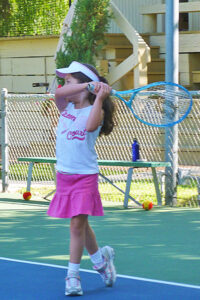 The Cognitive stage is generally defined as an information gathering stage. Where players have parts of a stroke broken down for them with slow repetitions and frequent feedback. During this stage the processing of information is very much paramount. Also called the Verbal-Motor stage (Adam’s, 1971) this requires knowledgeable feedback to the student from a coach. After all a player can certainly strike the ball over the net and have success while using a stroke that is ineffective.
Now as many coaches who have adopted the methodology of completely skipping the Cognitive stage would tell you. “Every ball is different.” “You have to move to the ball to hit it.” Etc This is actually true and all accomplished during the Associative stage. It’s at this time, AFTER players have gained effective information that they can gain independence and use outcome based information to make adjust and improve.
Is it easier to keep the beginning stages of tennis fun just letting players go out and swing at the ball however they feel is natural? Sure. But will it lead to less enjoyment as they are unable to improve? Frustration and injury are two of the leading causes of people dropping out of the game and both of these are the result of not learning proper fundamental initially. The reason good teachers are such a rare bread is that making learning fun is hard.
The good news is that tennis teachers CAN make learning proper fundamentals fun! This is where the term “Game Based” is actually rooted. It’s not meant to simply go out and learn a sport by playing it in its final form from the beginning. It’s used as a ay to format skill acquisition in a more engaging manner. For example one of my favorite beginner tennis games is tennis soccer where one player has to hit a ball on balance with a good stroke. The other player simply tries to block the ball from going through the cones. If the swing isn’t correct even if the ball goes through it doesn’t count.
As much as coaches would like to romanticize the game of tennis, the fact is that high level players are remarkably similar when it comes to crucial fundamentals. And these fundamentals are NOT natural. But at this point it seems more a matter of luck and only very special athletes learning these key, counter intuitive positions.
I agree the goal SHOULD be to get players out of this cognitive stage as quickly as possible. Players could spend just a matter of a couple months learning fundamentals and then have their whole tennis lives to just enjoy the last “Autonomous” stage of tennis.
Maybe it’s not necessarily trying to create systems that skip a crucial stage of development to make the game more fun…but to better train coaches how to teach fundamentals in a more fun way.
I’ve simplified fundamentals down to just a few key principles and checkpoints I think kids HAVE to learn to enjoy tennis for a lifetime. Hopefully my free course on teaching kids tennis can help others have a better understanding of player development. Check it out and let me know what you think? Teaching Kids Tennis – Jeff