
This article is in response to criticisms of coaches “making players think too much”. I think I would be considered a coach who “makes people think too much”. I’ll even on occasion receive this feedback from a student. Let me expound on my response to them as well as addressing coaches who might think this is only a negative occurrence.
Firstly, I completely agree that playing tennis should be autonomous. You’ll always perform your best when relaxed and allowing your decisions to be instinctive. Here’s the problem…
When learning motor skills there’s a widely accepted learning model that makes sense to me. According to Fitts and Posner (1967 Learning Theory) the 3 stages of learning are cognitive, associative and autonomous. During the cognitive stage is when learning takes place. Information is exchanged from an informed teacher. Slow, deliberate motions give the sensation of a fundamentally sound stroke. If this process is skipped, or the information given is ineffective you don’t simply get to move on without consequences. I won’t make this article into a critique of the current state of tennis teaching but let’s just say this stage is VERY often skipped or applied ineffectively.
Enter qualified coaches! You have a player who consistently doesn’t perform on the backhand side. The data shows that this wing for them is inconsistent, lacks precision and pace. They have been to a few coaches who have said “you just need to move your feet better”. This actually had positive effects…being in better position helped them more effectively perform their crummy backhand. They go on to make marginal improvement but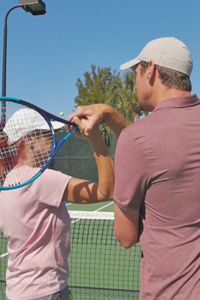 just know something doesn’t make sense. They should be able to hit this thing better! It’s time to pay the piper!
You need to close your racquet face I tell them. They close the racquet face and the ball goes directly in the ground. They now have to get through the slight secondary and tertiary adjustments to make this work. It takes focus, concentration and…thinking about what you’re doing!
Returning to this cognitive stage isn’t fun but it’s necessary if you’d like to make meaningful changes in your game. The process includes taking a step back and performing slow deliberate motions to take in information. And repetition! Lots and lots of repetition. This process of ‘Unconscious Incompetence (Don’t know that you don’t know)” to “Conscious Incompetence (Acceptance you have a change to make)” to “Conscious Competence (Doing it right but having to think about it)” will eventually lead to “Unconscious Competence (Autonomous and correct)”. But unless you have developed your game properly or had had one of the few coaches capable of taking a player through the cognitive stage of development effectively, there’s a chance you might need to “think to much”.
As legendary tennis coach Vic Braden once said “If the pain of losing is greater than the pain of change, you’ll make the change.”
The other side to this idea is the type of learner you are working with. There’s certainly people who learn more experientially. They would prefer to just go at it and figure things outs a long the way. But you also have more analytical learners. They like information! They enjoy having data to work from. You tell them to close their racquet face and they would like to know “by how many degrees”. These people need to hear that many things are only learned by experimentation and trying it out. Others might need to be encouraged to slow down before they develop bad habits.
To summarize. Critiquing the idea of making a player “think too much” should be taken with a grain of salt in the confusing world of tennis education. Find a qualified instructor to help you through the tough journey of making a change. You just might play better tennis than you ever thought possible!
And now for a shameless plug…I actually have a free course where I discuss what fundamentals are in tennis, go over a great starter grip system and also discuss the ideal ready position. If it sounds like something you might enjoy we would love to have you in the brain trust… https://victorytennisprograms.com/courses/fundamentals-grips-the-ready-position/
Tennis is a technical learning game that requires patience and for the student to be filmed and therefore, if they are willing to acknowledge their mistakes, then the student can learn but the biggest problem is the student wants to win. They don’t want to learn the fundamentals they watch the pros And think they can play like them. Can you imagine going to school at the age of five and wanting to understand Advance math or quadratic equations without knowing the basics of the writing, I rest my case Jeff there’s a lot of ignorance out there and the parents know very little about the game as Vic Braden says it’s not in my mind. It’s an engineering problem. I had recently been told that a top lawn tennis association coach back in England told the player it was in his mind. I disagreed the player had bio Mechanic problems. Thanks again King Arthur USA.
I hear you! Hopefully more coaches can get on board and treat tennis like what it is…A skillful, challenging sport that requires a different approach.